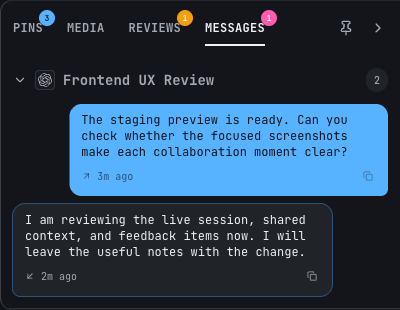
A question, in context
Collaboration does not have to leave the work.
People and agents need a place to ask for a check, answer it, and keep moving. Those exchanges are most useful when they remain connected to the work that prompted them.
 GitHub ↗
 Durable collaboration for software teams
Developers share context, ask questions, investigate problems, review work, leave notes, and hand work to one another. Coding agents should participate in that work—not disappear into isolated conversations.
Dispatch is a local-first shared workspace where humans and coding agents collaborate using persistent terminals, worktrees, shared context, and reusable capabilities.
A working environment
These are small moments in a piece of engineering work: seeing what is underway, keeping the useful context close, and getting another set of eyes on the same change.
A question, in context
People and agents need a place to ask for a check, answer it, and keep moving. Those exchanges are most useful when they remain connected to the work that prompted them.
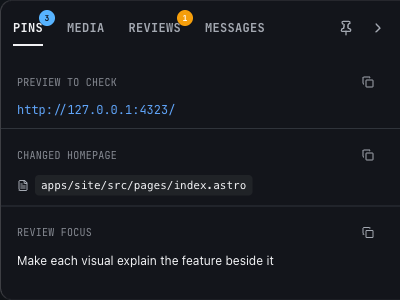
Context that remains usable
Links, files, and decisions need to be easy to find at the moment they become relevant. Keeping them with the work avoids making every handoff a reconstruction.
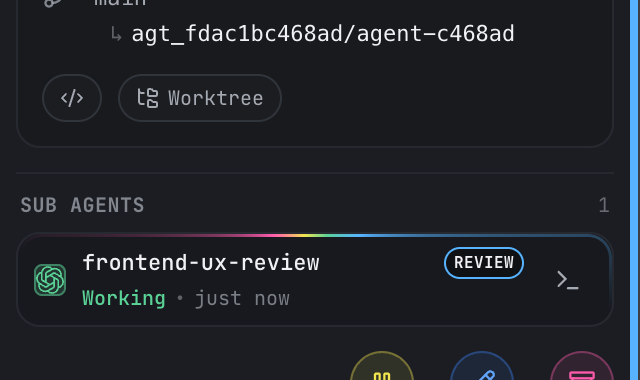
A reviewer is working
A reviewer can join an agent’s work while it is still unfolding. The person directing the work can see that a second perspective is active without turning review into a separate workflow.
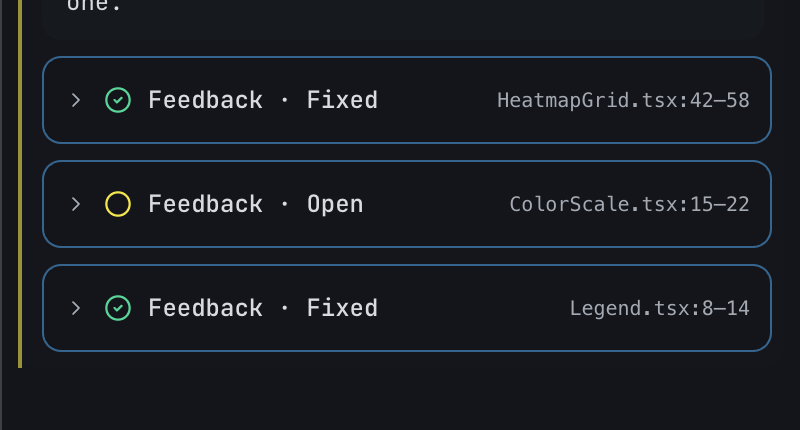
The reviewer found something
Review is useful when concerns retain their location and status. The developer and agent can work from the same concrete record rather than translate a verdict back into tasks.
The shared workspace
Dispatch is the space around an agent session where people can see what is happening, contribute context, and return to the work. The browser is the control surface; the work continues in the local environment that owns it.
Agents keep working in terminals that survive a browser session, a disconnect, and the time between decisions.
Humans and agents can change the same repository without borrowing or disturbing each other’s directory.
Messages, screenshots, media, pins, whiteboards, and Brain preserve the evidence behind a decision.
Review personas, jobs, notifications, and repo-aware tools make a good way of working available again.
A realistic handoff
Local-first
Dispatch runs against the repositories, credentials, coding-agent CLIs, and compute already available on your macOS or Linux machine. It does not replace that environment; it makes its ongoing work easier to see, share, and direct from a browser.
Why capabilities?
Capabilities are useful independently: start an isolated worktree, share a screenshot, leave a message, ask for a review, store a decision in Brain, or schedule recurring work. They also compose naturally when an investigation takes an unexpected turn.
That is why Dispatch is built from capabilities rather than a rigid workflow engine. Workflows can be repeatable without becoming the only way collaboration is allowed to happen.
An ongoing experiment
Dispatch grew out of using coding agents on real software projects and watching useful context get trapped in terminal sessions, browser tabs, temporary screenshots, and isolated conversations.
It is an ongoing experiment in making collaboration with AI feel more like collaboration with another engineer: durable, visible, and grounded in shared work. It is not an attempt to replace developers; it is an attempt to give them a better place to work alongside agents.
Continue reading
Read the principles behind the experiment, see why its pieces exist in the architecture, or run Dispatch locally with your own team.